Cockatoo Island has, for me, a familiar face. I grew up in an adjacent suburb; the playground of my primary school looks out over the southern shore of this eighteen hectare island in Sydney Harbour. In 2005 I was invited to produce an installation for the inaugural Cockatoo Island Festival (CIF), which was held during the Easter holiday of that year. Because CIF was an all-ages rock festival, in a location with considerable historical significance to the Sydney public, the audience expected by the organisers was quite different to the traditional museum or gallery attendee.
After visiting the island and researching its history, I decided to create something with echoes of its past. Since European settlement in 1788, Cockatoo Island has been mostly used for shipbuilding and repair, but it has also been used, beginning in 1839, as a convict prison, a home for wayward teenage boys, a gaol, as a Customs’ quarantine area and as the Biloela Public Industrial School and Reformatory for Girls. It was the last that most interested me.
In an attempt to surprise and intrigue, as well as to promote reflection and conversation on the history of island, I developed an ethereal video work in which a girl from the distant past runs, intermittently, across the inside of a set of windows that face a common lane-way on the island. She runs from dusk to dawn, backwards and forwards, over the same ground.
History of the site
As a prison, Cockatoo Island was not a nice place. Prisoners of all kinds were crowded together in inadequate accommodation. The solitary confinement cells were frequently occupied. And one of the cells was so small its occupant could only stand. (Jeremy, 2005)
By all accounts the island was always a rather inhospitable place. According to Cockatoo Island historian John Jeremy there was no evidence of Aboriginal use of the island prior to its inception as a Colonial gaol in 1839. The first permanent European residents were convicts, who were immediately drafted into building themselves a prison and providing for future life on the island by digging a well and clearing the land. In deplorable conditions they then built the first of the island’s various docks and shipyards. The conditions were so poor that, at night, the guards had to be protected in a newly constructed guardhouse, built to keep them safe from convict attack. These conditions prompted official calls for a public enquiry into the way the island was run. Finally, in 1858, a Board of Enquiry was created to examine the management of the Cockatoo Island Penal Establishment. Despite the report’s harsh criticism it took more than ten years (1869) before the break-up of the Penal Establishment was approved and the prisoners were relocated to Darlinghurst. (Parker, 1977; Kerr, 1984; Jeremy, 2005).
After the prisoners were removed from the island it was turned into an industrial school for girls, with a separate reformatory for young female offenders. The island also briefly got a new name, ‘Biloela’ (the local Aboriginal word for Cockatoo), in an attempt to ameliorate its convict prison past, but the island itself did not receive a make over. A short time later it received a further boost to its population when the sailing ship Vernon, purchased by the government for conversion for use as a training ship for wayward and orphaned teenage boys, was moored on the eastern shore. The reformatory and industrial school were separated from the rest of the island by a corrugated iron fence, although, as the conditions once more deteriorated, contact between the imprisoned girls and the wayward boys was
inevitable…
Three girls came down abreast of the ship, in a semi nude state, throwing
stones at the windows of the workshops — blaspheming dreadfully and
conducting themselves more like fiends than human beings. I was
compelled to send our boys onto the lower deck to prevent them viewing
such a contaminatory exhibition.
I. V. S. Mein, superintendent of the Vernon school, October 18713.1
Although it was quickly and clearly apparent that the island was inappropriate for housing already troubled young girls, it was not fully closed for another 20 years. The Reformatory was closed in 1880 and the girls moved to the Shaftesbury Reformatory, South Head, New South Wales. The Industrial School stayed on the island until 1887/8, when it was closed and relocated to an old school site in Parramatta where it stayed, in various guises, until 1975 (NSW Government, online).
After the removal of the twin girls’ schools, the island was quickly redrafted as a prison to ease overcrowding at the Darlinghurst Gaol. It remained as such until 1908 when Cockatoo Island’s convict days were finally put to rest.
For the majority of the remainder of Cockatoo’s active life it was as a dockyard used for shipbuilding, repair and refitting. This is a legacy that has left the island’s docks dangerous to human contact. Between 1857 and 1992 more than 12,000 vessels were docked for repair or maintenance and it was, for a short time during the Second World War, the main ship repair base in the South Pacific (Jeremy, 2005). There is little or no mention of indigenous connection to the island in the official histories. This is despite the establishment of a satellite branch of the Aboriginal Tent Embassy on the island from 20th November 2000 to 12th March 2001 (Connolly, 2000).
In 2001 the Commonwealth Government handed the Sydney Harbour Trust control and management of the island, the largest of eight in Sydney Harbour. The Harbour Trust initiated the Cockatoo Island Festival after spending millions rehabilitating the island, and has plans to give it a slightly brighter future.
Biloela Girls
As in the convict era, treatment of girls comprised a mixture of sublime indifference to their personal welfare and prurient interest in their sexuality. At the New South Wales Industrial School and Reformatory, at first located in old military barracks at Newcastle, girls rioting there were said to have exposed themselves naked at the windows and from the top of the building. Unlike boys, they were likely to have been removed from the street not for mischief or petty theft but for being in ‘moral danger’ and once ‘fallen’, it continued to be assumed, their sexuality was out of control. In 1871, the school was removed to Cockatoo Island, thoughtfully renamed to Biloela to remove any convict memories associated with the site. But here, too, the girls seemed determined to regress towards the convict stereotype, singing ‘improper songs’, it was alleged, and indulging in ‘disgusting sexual practices’. Punishments were extreme. A New South Wales Commission of Public Charities visiting Biloela in 1872 found that rioting inmates had been ‘beaten, kicked and dragged by the hair’. Eight girls were found locked in a small room without adequate clothes, bedding and toilet facilities and in absolute darkness. They had been there for days and seemed ‘half-crazed’. (Kociumbas, 1997)
Of the varied histories of Cockatoo Island, the one that stayed with me was that of the troubled teenage girls and their treatment. Not only how they were treated on the island, but how girls and boys through Australia’s history had, on occasion, been treated in care and how we, as a society, deal with and remember those who suffered. This path of investigation led, via accounts from the time and even some of the place, to organisations such as the Care Leavers of Australia Network (CLAN). CLAN is a self-funded support network for those who have, in their past, lived in care, in some cases in institutions such as Biloela.
Through petitioning, CLAN and others were largely responsible for the Australian Federal Government’s Senate Inquiry into Children in Institutional Care, the report from which was, influentially for this work, entitled Forgotten Australians. To remember the “students” from Biloela’s Industrial School and Reformatory, the work was named Biloela Girls.
The Committee considers that there has been wide scale unsafe, improper and unlawful care of children, a failure of duty of care, and serious and repeated breaches of statutory obligations. The Committee further considers that many comments in recent years by governments, churches and care providers reveal a complete lack of understanding of or acceptance of responsibility for the level of neglect, abuse and assault that occurred in their institutions. (Commonwealth of Australia, 2004)
A need to regain their past, to have it dealt with and acknowledged, drove some people to demand an enquiry which required, of them, to recall their diverse ordeals. This need also inspired Biloela Girls. I wanted to create something that embodied a haunting memory, and in particular one that was trapped in the Biloela girls’ time, and on their island.
Experiential aims
The experiential impetus for this work was the desire to lure unwitting passers-by, people who had not specifically set out to have a visual art experience, into a dialogue with the site, with the people around them and, hopefully, with the work and its themes. All of the design and implementation decisions made, both in development and while the work was installed, were informed by this aim.
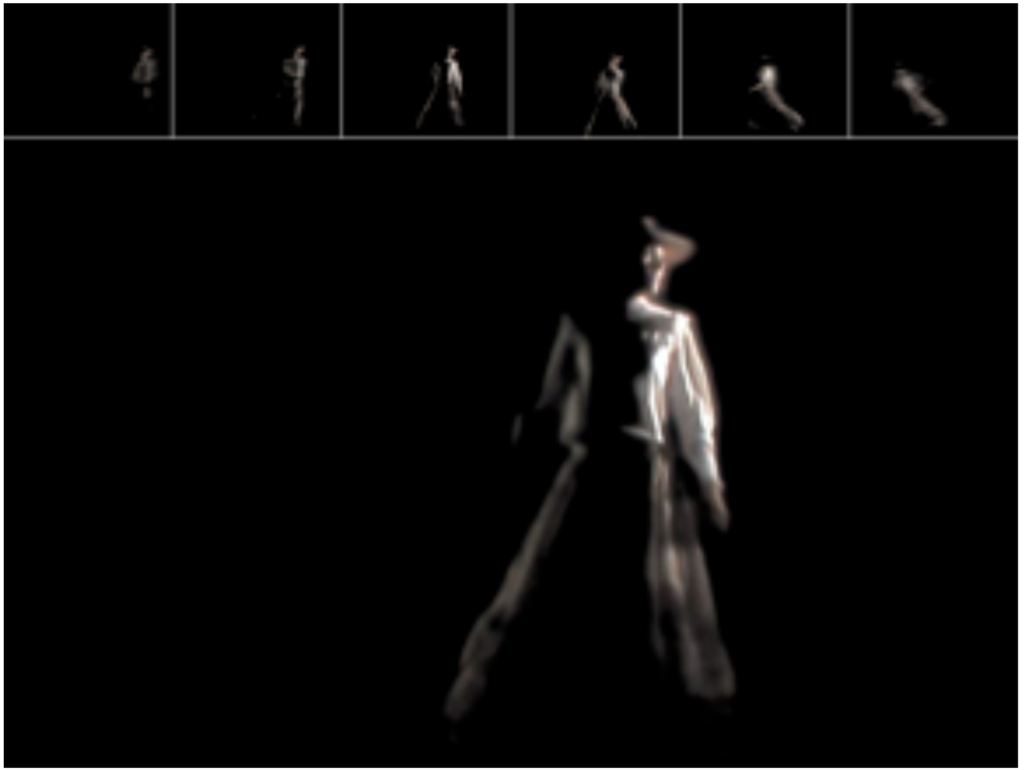
Biloela Girls is a projected video work, in which a ghostly characterisation of an inmate of the reformatory is stuck in a never-ending loop. Forever running, as if chased, over the same ground. Most of the time the video is empty, black, and each passing of the character is fleeting and ethereal. The video is projected onto a curtain-like screen set inside an unmarked and nondescript window that faces out onto a common thoroughfare. From the outside it looks as if there is a cream and white ghost, in late nineteenth century attire, running scared past the windows, inside the room. The room inside the building is locked and the door covered. The projection began at nightfall and continued to sun-up.
The windows that house the projection are not in the direct line of sight of someone walking down the thin path between the two buildings, as such, most users’ initial contact with the work is through their peripheral vision. It was hoped that she would appear as a fleeting phantom, and that those that witnessed it would not be sure if it had happened or not, or what they had seen. To see the image clearly would require some tenacity and patience. In keeping with the experiential intent of the work, the projection was placed such that only some people who walked past it would see it, in the hope that they would engage with others, perhaps even strangers, to seek out what had initially grabbed their attention.
The Installation
During my first official visit to the island I scoured the two dedicated arts spaces for a site that would accommodate the twin goals of inadvertent audience participation and the ability to configure and covertly observe the work while it was running. A room was located in the old Pattern Storage/Joiners Shop, which was being used as a gallery, and which met all the requirements. From the back of the rectangular room it would be possible to project, with the equipment that was already available to me, a video on three by four meter window, which would be covered by a back projection material. A material was chosen that would look like a cheap curtain. The material was hung loosely, but still conveyed the image of the girl to anyone using the lane. The projector was mounted on its flight case and oriented such that its throw covered the whole window, giving it a uniform look from the outside.
The video content was a delivered via a looping Quicktime video file, running on an Apple iBook laptop. The windows were situated part way along a common through-fare between the lower area of the island and the top stages. This position guaranteed a lot of traffic during the feasible projection time, from thirty minutes after sunset (approximately 6:30 pm) until the close of the top section of the island to festival goers (approximately midnight). Directly across the small roadway from the projection was an empty room that facilitated covert observation of the work in situ.
Creating the video
In Biloela Girls I wanted to capture the girl’s fear and energy, to incorporate the way care-leavers talk about being trapped in their past. Further, to remember them and the history of the island.
With technical assistance from Greg Ferris, I filmed a female actor, Alex Hamblin, running through a large dark room. From more than thirty passes, five from left to right and five from right to left were selected that most accurately articulated the feelings we were trying to capture. In some she was head down, some looking over the shoulder, others were stop and start, but all were furtive, fleeting, hunched and harried.
During each pass she was lit by two direct lights, one to the left of the camera’s field of view pointing right, and the other oppositely positioned. Alex was then filmed running left to right, and right to left across the camera’s field of view (FOV). The actor fully exited the FOV with each pass, allowing for the frequency of her movements to be adjusted to fit the different versions of the work. The lighting set-up meant that Alex’s clothes were only ever lit from the back or the front as she ran. This caused a two fold effect, firstly that she always looked like she was running from a light to a light and secondly that the centre of her body would, at times, totally disappear. Alex was dressed in a period costume that matched, as closely as possible, images found in Australians 1888 (Davison et al., 1987) and textual descriptions in Robert Hughes’ The Fatal Shore (Hughes, 1987), of poor or incarcerated women of the era.
A time based semi-transparent echo was used to give the character a ghostly look. The ten short passes were used, alternately, to give the impression that the character was imprisoned in the room. There were two different versions of the video created for the first two days of the festival, a third was planned that would be created during the festival, incorporating what was learned during the first two
screenings.
- This quotation is taken from a letter to the New South Wales Principal Under Secretary. Originally cited in Cockatoo Island: Sydney’s Historic Dockyard (Jeremy, 2005).
Commonwealth of Australia. Forgotten Australians: A report on Australians who experienced institutional or out-of-home care as children. Commonwealth of Australia, August 2004. URL
Ellen Connolly. No trespass, Cockatoo is ours, declare aborigines. Sydney Morning Herald, December 2000.
Graeme Davison, J. W. McCarty, and Ailsa McLeary, editors. Australians 1888. Australians: A Historical Library. Fairfax, Syme & Weldon Associates, Broadway, NSW, Australia, 1987.
Robert Hughes. The Fatal Shore. Collins Harvill, London, United Kingdom, 1987.
John Jeremy. Cockatoo Island: Sydney’s Historic Dockyard. UNSW PRESS, revised edition, March 2005.
Jan Kociumbas. Australian Childhood: A History. Allen & Unwin, Australia, Febuary 1997.
J S Kerr. Cockatoo Island: Penal and Institutional Remains. National Trust of Australia, Sydney, 1984.
NSW Government. State records nsw – archives in brief 59 – child care and protection. URL
R G Parker. Cockatoo Island: A History. Thomas Nelson, Melbourne, Australia, 1977.